
SlotLair withdrawals: published limits, timelines and verification
 Available in GB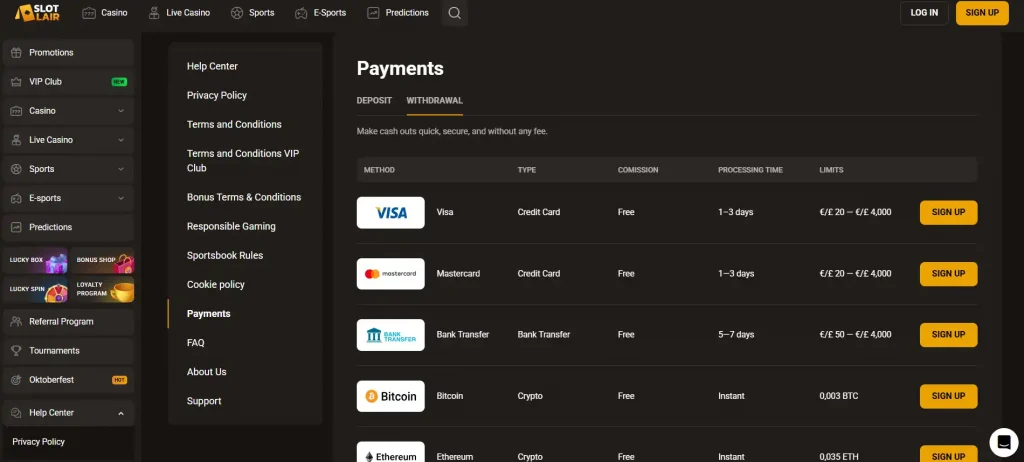
SlotLair’s general terms, section 11.4, publish standard GBP ceilings of £3,000 per week and £15,000 per month, with higher lifetime-deposit tiers and potential reductions elsewhere in the policy. The public payment table lists card withdrawals at 1-3 days and bank transfers at 5-7 days. These are method estimates, not bank receipts for an individual account. Identity checks and method-specific limits can also apply; the outcome of a particular British withdrawal remains unestablished.
Table of Contents
Two schedules govern the same withdrawal request
The general terms specify account-level weekly and monthly ceilings, while the payment table sets out method-specific minimums, displayed ranges, fee labels and estimated times. They are not interchangeable. For example, an account ceiling of £3,000 in one week does not guarantee that every single payment rail will accept a £3,000 instruction at every moment, and an upper limit of £4,000 in a public method row does not cancel the account ceiling. The terms state that the maximum available for the chosen method will be shown when selecting that method.
| Method | Public minimum and range | Published time | Displayed commission |
|---|---|---|---|
| Visa | £20 to £4,000 | 1-3 days | Free |
| Mastercard | £20 to £4,000 | 1-3 days | Free |
| Bank transfer | £50 to £4,000 | 5-7 days | Free |
| Bitcoin | From 0.003 BTC | “Instant” in table | Free |
| Ethereum | From 0.035 ETH | “Instant” in table | Free |
| Litecoin | From 1 LTC | “Instant” in table | Free |
| Dogecoin | From 650 DOG | “Instant” in table | Free |
| Tether | From 50 USDT | “Instant” in table | Free |
The general terms’ minimum withdrawal is £20 or €20, yet the bank-transfer row starts at £50. This is a good illustration of why the general minimum cannot be read as a universal minimum for every rail. The cryptocurrency rows use their own token quantities and should not be silently converted into pounds. The table’s “Instant” description is particularly limited: it does not tell us whether an individual request waits for identity review, payment-provider processing or confirmations before a recipient can use the money.
The method table also labels Visa and Mastercard as “Credit Card”. This records the wording of the public global page; it is not evidence that a British customer can use a credit card to gamble. For a narrower account of the UKGC rule and the distinction between network logos and card funding type, see the deposit and payment overview. Here, the important point is that a published card payout route is not a live GB payment test.
Standard account ceilings and lifetime-deposit tiers
Section 11.4 sets the base £3,000 weekly and £15,000 monthly limits. Sections 11.5 to 11.7 describe higher limits depending on the total amount previously deposited over the life of the account. These are published conditions, not a suggestion to deposit more to obtain a higher withdrawal tier. Depositing funds to chase a payment limit introduces additional financial risk and does not remove verification or other stated restrictions. The source says the monthly limit resets on the first day of the month and treats progressive jackpot wins separately, stating they are paid in full.
| Lifetime deposits in the terms | Weekly ceiling | Monthly ceiling |
|---|---|---|
| Standard band | £3,000 | £15,000 |
| More than £2,500 | £5,000 | £20,000 |
| More than £50,000 | £7,500 | £30,000 |
| More than £100,000 | £20,000 | £120,000 |
The “more than” wording matters at a boundary. A stated lifetime total exactly equal to a threshold is not the same as more than it. These bands refer to deposited history and do not establish the amount any player has withdrawn, won or retained. They should be read as an account-level ceiling calculation, subject to the other clauses. Nothing in the existence of these higher tiers proves that they have been applied to a UK account or that an individual player received a larger payout.
Two reduction provisions stop the largest table number being a complete description. Section 11.8 allows a reduction to 50% of monthly limits when the balance is at least ten times the total sum deposited. Section 11.10 permits the operator to reduce limits to £1,000 weekly and £5,000 monthly if the player’s total stakes fall below the printed £5,000 per week and £20,000 per month thresholds. A reader comparing a live account with the public table must consider both the relevant tier and applicable reduction clauses, rather than selecting whichever single number looks most generous.
When a request becomes eligible for processing
There is a difference between a cash balance, money linked to a recent deposit and a promotional balance. Clause 9.7 sets a one-time wagering requirement for deposited funds before a related withdrawal becomes available. It also says deposits with no betting activity can be aggregated for this purpose, and it allows a higher three-times requirement where the operator suspects money laundering or other fraud. Clause 11.2 separately permits recovery of transaction-processing costs when stakes since the last deposit are below three times that deposit. These are distinct published provisions, not a single universal three-times bonus requirement.
Promotional funds introduce their own terms, including the advertised wagering condition and restrictions on withdrawing before completion. A withdrawal request should therefore be evaluated against the actual account’s cash, deposit-linked and bonus-linked balances separately. The bonus conditions describes the operator’s published offer language and why that is not proof of a redeemable GB promotion. Do not assume that meeting an ordinary deposit-turnover clause completes any separate promotional requirement.
The operator also says that depositing without betting and then withdrawing can give rise to fee recovery. That is why a “Free” cell in the payment schedule must be read together with the general terms. The table lists standard commission; the terms reserve particular additional costs under defined circumstances. Neither source establishes what fee, if any, an actual player was charged in a given transaction. A proper account-specific record would include the fee displayed at the time and the written explanation of any later deduction.
Identity review: what the operator actually states
Under clauses 9.1 and 11.3, SlotLair reserves the right to check identity before processing payouts and to hold a withdrawal or refund while verification is undertaken. Section 8.5 names passport details, identity cards, residence documents and source-of-funds statements as possible documents; it does not say every person must upload every example. Section 9.8 also discusses verification of ID, payment systems and utility bills, including a possible video check in a language-script circumstance. The document request is account-dependent, and the terms give no fixed identity-review duration.
False or incomplete data can lead to a refused withdrawal or account termination under the terms. Account and payment-method identity checks are relevant because the operator’s deposit policy prohibits third-party payments. The same person should be identifiable across the player account and their named funding method. An incomplete document submission, a name mismatch or an unresolved source-of-funds request is a different documented category from a bank that has not yet posted an approved transfer. The two should not be treated as one unexplained “slow withdrawal”.
The public terms do not provide a dependable fixed identity-review deadline. Likewise, the operator’s listed card and bank windows should not be added to an invented verification interval to manufacture a total turnaround time. The separate KYC information keeps account document requirements distinct from the advertised payment timetable.
Request, review, transfer and arrival are different statuses
A usable timeline has several checkpoints. First, record when the account submitted the withdrawal request and which method, currency and amount appeared on the screen. Second, note whether the operator requested identity or payment documents and when that request was answered. Third, note the status of any approval, rejection, reversal or change in amount. Fourth, distinguish a provider transfer reference from the date that money reaches the destination account. The public payments table cannot fill these checkpoints for an individual player.
If a request is marked pending, do not infer the cause from status alone. The terms give the operator identity-review powers and method-specific restrictions, but they do not supply the reason for every pending request. A rejection can require a different explanation from a payment that was approved and later returned by a provider. Ask support to identify the relevant term and the stage currently outstanding. Keep transaction IDs and images private except through authenticated official support.
| Record | Example of what to preserve | Why it matters |
|---|---|---|
| Request | Local date/time, amount, currency, method and reference | Separates submission from completion |
| Terms | Relevant public clause and actual cashier limits displayed | Shows which rule was visible when requested |
| Verification | Date of official request and confirmation of submitted response | Identifies review interval without publishing personal data |
| Support | Case number, date and written answer | Preserves the stated reason for delay or refusal |
| Settlement | Provider transfer reference and bank receipt date, if any | Separates approval from arrival |
An account may show only some of the listed request statuses or reference details. Where an item is absent, do not invent it. Remove balances, document numbers and personal contact details before posting about a dispute. A stranger asking for credentials or a payment to ‘release’ winnings is not an authenticated operator support channel.
What public complaints can and cannot prove
Public complaint platforms include SlotLair payout disputes. A recorded UK complainant in a 2026 Casino Guru thread later confirmed receiving the disputed money, while the remaining account-closure issue was not conclusively investigated after the player stopped replying. That is a chronology for one account, not a representative distribution of payment times. The payout report does not prove that every UK customer can deposit or withdraw today, and the unresolved closure question should not be rewritten as a confirmed finding on an unrelated withdrawal.
The dedicated complaints and dispute records page preserves that case’s dates, separates allegations from replies and explains how to document a support escalation. It also distinguishes a public review procedure from regulator-prescribed alternative dispute resolution. A complaint about SlotLair cannot itself establish that a regulator-approved dispute provider has accepted an account dispute.
Published account ceilings and method estimates are not the same as a completed British payout. Read limits in their order of application, separate identity review from bank receipt, and keep the actual account dates and responses together. One public complaint cannot establish a typical payout result. The main review covers other product and licensing questions.
Recommend

SlotLair registration and KYC: account rules, documents and mobile access
SlotLair UK Guide | Account terms and mobile access | 28 September 2026 SlotLair's published...

SlotLair licence and safety: UKGC register checks and player protections
SlotLair UK Guide | Licence and consumer safeguards | 28 September 2026 A current UK...

SlotLair bonuses: welcome deposits, free spins and wagering terms
SlotLair UK Guide | Casino promotions and conditions | 28 September 2026 SlotLair's official bonus...

SlotLair games: slots, live casino and software suppliers
SlotLair UK Guide | Casino games and suppliers | 28 September 2026 SlotLair displays slot-game...

SlotLair payments: GBP deposits, card and crypto options
SlotLair UK Guide | Deposits and payment options | 28 September 2026 The published payment...