SlotLair payments: GBP deposits, card and crypto options
 Available in GB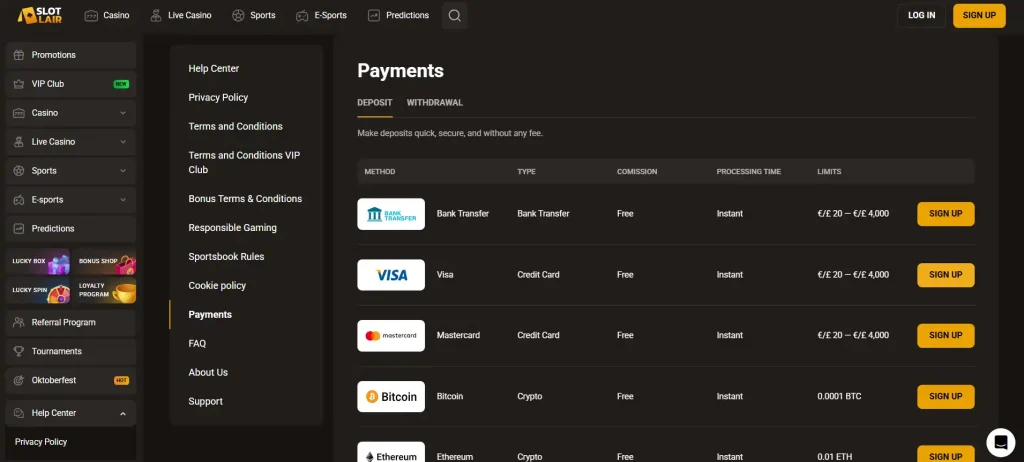
The published payment position: SlotLair’s general terms allow EUR and GBP and set a £20 or €20 minimum deposit. Its public payments table lists bank transfer, Visa, Mastercard, Bitcoin, Ethereum, Litecoin, Dogecoin and Tether. The fiat rows show a £20 to £4,000 listed deposit range and label Visa and Mastercard as “Credit Card”. That label must not be read as evidence of an available, lawful credit-card route for a British customer: UKGC-licensed operators are prohibited from accepting consumer credit-card gambling payments, including credit-card-funded wallets. A GBP method in the global table does not establish an actual British account payment. The figures describe the published global table, not a successful UK checkout.
Table of Contents
- How the public payment schedule differs from the cashier
- GBP denomination and the £20 minimum
- Visa and Mastercard: credit is not the same as debit
- Crypto rows: names rather than exchange promises
- Fees, transaction stages and the deposit-versus-withdrawal distinction
- Financial limits for licensed GB operators in September 2026
- Method-specific limits and account conditions
How the public payment schedule differs from the cashier
The casino’s public schedule has separate deposit and withdrawal tabs. The deposit side gives a method name, category, fee label, advertised processing time and range. A publicly accessible table is useful because its claims can be read without creating an account. It is not a personalised cashier screen. An individual payment option can be affected by jurisdiction, payment provider, account status and the particular currency shown to that player. This distinction matters especially where the visible card type raises a GB regulatory question.
| Published rail | Published category | What the page establishes | What it does not establish |
|---|---|---|---|
| Bank transfer | Bank transfer | Listed with a £20 to £4,000 GBP row | Acceptance by a particular UK bank or completed transfer |
| Visa | “Credit Card” on the operator table | A named card-network row | That a British credit card is permitted or that every debit card works |
| Mastercard | “Credit Card” on the operator table | A named card-network row | A tested GB deposit or a verified debit/credit product distinction in the cashier |
| Bitcoin and Ethereum | Crypto | Named cryptocurrency deposit categories | A guaranteed wallet, chain or current account quote |
| Litecoin, Dogecoin and Tether | Crypto | Further named cryptocurrency categories | Any assumed conversion between pounds and tokens |
The operator table calls the deposits “Free” and “Instant”. Those are the operator’s displayed labels, not independently measured end-to-end performance or proof of zero third-party charges. A bank, intermediary, card issuer or network could have its own terms, while the public table does not disclose how every provider will treat a particular UK transaction. It is more accurate to quote the operator’s fee line than to promise every payer will incur no cost or experience instantaneous settlement.
Compare the published row with the method displayed to an eligible account and the provider’s actual result. The advertised row does not establish the outcome for an individual account. The same distinction applies to the separate withdrawal timings, where an advertised payout interval is not the date that cash reaches a bank account.
GBP denomination and the £20 minimum
The published currency clause explicitly says EUR/GBP and its minimum deposit clause says 20 EUR/GBP. For someone reading in pounds, £20 is therefore the relevant displayed fiat floor. This is not a conversion from euros and it should not be multiplied by an invented exchange rate. It is the direct GBP amount printed in the operator terms. The payments page also displays the upper end of its standard bank-transfer and card deposit rows as £4,000. The public row does not prove that an individual account has the same maximum.
The £20 minimum is a transaction floor, not a responsible-gambling recommendation or a promise that a £20 transfer will be accepted. The general terms instruct users not to attempt deposits below their minimum. They also tell people to contact support about methods most suitable for their country of residence. If the cashier differs from the public schedule, the country-specific response and the current on-screen conditions are the relevant evidence to record, rather than assuming the published range overrides a provider’s restrictions.
The operator says it does not act as a financial institution and provides no currency conversion or fiat-to-crypto exchange service. It follows that a row denominated in a token is not a promise that someone can deposit pounds and have the casino exchange them into that token. Read a displayed coin quantity in its original unit. Do not treat a token minimum as a sterling minimum without a separately sourced exchange rate and a demonstrated supported path. The table does not provide a universal sterling equivalent for the crypto rows.
One payment-method detail that is easy to miss is ownership. Clause 10.3 says deposits must come from a method registered in the player’s own name, not a third party’s card or bank account. The text describes consequences when a third-party deposit is discovered during checks. The payment owner should match the account holder, and the customer should retain the relevant transaction record.
Visa and Mastercard: credit is not the same as debit
The UK Gambling Commission’s credit-card guidance explains that affected GB gambling operators must not accept consumer credit-card payments. It also covers money loaded to an e-wallet by credit card before the wallet is used for gambling. Debit cards have a different funding basis, and the appearance of a Visa or Mastercard logo alone cannot tell a reader whether the instrument is debit or credit. The network name and the financing type answer different questions.
SlotLair’s public schedule uses the label “Credit Card” for Visa and Mastercard. That global label is not an exception to the UKGC restriction on consumer credit-card gambling payments by its licensees, nor does it establish that a debit-card cashier option is available for a particular British account. Card-network names and the actual permitted funding instrument are different facts; the published table alone does not resolve either the British account or the operator’s licence position.
A brand’s local regulatory position is a distinct question from its published catalogue of deposit methods. The licence evidence explains the official register context and the territorial distinction between Great Britain and Northern Ireland. A payment listing or a UK-themed review is not proof of authorisation, consumer protection coverage or access to any particular licensed dispute route.
Crypto rows: names rather than exchange promises
Bitcoin, Ethereum, Litecoin, Dogecoin and Tether appear as separate entries on the published deposit schedule. Their networks, receiving addresses and settlement conventions are not interchangeable. The destination, token identity and applicable network need to match the sending service’s instructions. A global digital-currency row does not establish that a particular chain, wallet integration or payment route is available to a customer in Great Britain.
The named cryptocurrency rows do not exempt a customer from identity, payment ownership or other account conditions. The operator’s terms separately authorise identity checks, payment-account checks and payout holds when requested. The presence of crypto does not remove the need to understand which person owns the payment method and which terms apply to the account. A published crypto row also says nothing about the availability of a particular cryptocurrency to a particular customer through their chosen external provider.
For personal records, retain the transaction reference, token, network, time, amount and official destination shown at the time. Never publish private keys, seed phrases, identity documents or a live account session. Reject unsolicited addresses from third parties claiming to be support.
Fees, transaction stages and the deposit-versus-withdrawal distinction
There are at least two stages to a payment: the customer’s instruction to a provider and the resulting account credit. Even when a schedule uses the word “Instant”, it does not document how a particular transfer was routed, whether an account review occurred or what a UK provider displayed. A public commission cell is similarly narrow: it states how the operator describes its charge, not the full financial terms of every intermediary. For a particular payment, keep the initiation time, provider status, casino balance status and any written support response separate.
SlotLair’s general terms say that a deposit without betting can lead the operator to cover its fees if the balance is withdrawn. They also specify wagering of deposited amounts before related funds can be withdrawn, with separate discretionary fee wording if turnover is under three times the last deposit. Those are withdrawal-policy conditions, not a change to the public deposit row’s “Free” label. Their details, exceptions and documented limits are discussed on the dedicated cash-out page instead of treating depositing and withdrawing as one undifferentiated transaction.
Promotional eligibility is separate: the listed £20 banking minimum does not guarantee that a British account can claim a welcome offer or that every funding method qualifies. A bonus may have its own minimum and wagering restrictions even when the same number appears in the general terms. The separate deposit bonus conditions page distinguishes the operator’s published global schedule from the GB licensee framework. A payment-method listing does not establish that a particular promotion is available to that account.
Financial limits for licensed GB operators in September 2026
Great Britain’s financial-limit framework applies to UKGC licensees, not automatically to every brand with a GBP column. The Commission says its first phase began in October 2025: affected businesses should proactively prompt customers to set financial limits before their first deposit and make the relevant tools easy to access from the homepage and deposit page. A prompt to set a limit is a customer protection mechanism; it is not a statement of SlotLair’s account interface or proof that the brand implemented a regulator’s system.
The Gambling Commission’s 26 May 2026 extension notice moved the second phase of its financial-limit requirements to 30 September 2026. The requirements concern gross deposit limits, including their name and prominence among other financial controls. The rule applies to the relevant UKGC licensees and does not establish SlotLair’s licence position or the tools shown in an individual account.
Gross and net measures answer different questions. Gross deposit limits restrict funds added during a period without subtracting withdrawals, whereas a net measure can account for the difference between money added and money taken out. If a financial-limit screen is encountered, check the label and reset period rather than assuming two similarly named controls behave the same way. Nothing in the published £20 operator minimum is evidence that a customer should select any particular personal limit.
Method-specific limits and account conditions
Start by noting the date and currency of the public payment schedule. Then keep the card network, funding type and payment provider separate, especially where a row has an ambiguous or legally sensitive label. Where a real eligible account is involved, compare the method and exact conditions displayed there with the public row; preserve the source if they differ. Do not assume that the same method will be present for another resident, that a transaction completed because a button was displayed, or that support can override a statutory restriction.
Next, read the operator’s own ownership and verification clauses before treating the money as freely transferable. The presence of a fee-free deposit row does not cancel terms on withdrawals, identity checks or funds that have not met the published turnover conditions. The detailed account evidence and document examples belong in the account verification. This separation prevents a simple method comparison from quietly becoming an unsupported payment-success promise.
SlotLair publishes a £20 sterling minimum, fiat methods and five digital-currency options. Those descriptions do not show that a particular British account can pay by each route or that consumer credit-card payments are permitted for British licensees. The brand review covers the wider product and regulatory distinctions.